
Food Size Comparisons
Notice food features and use the question clues to compare the choices.
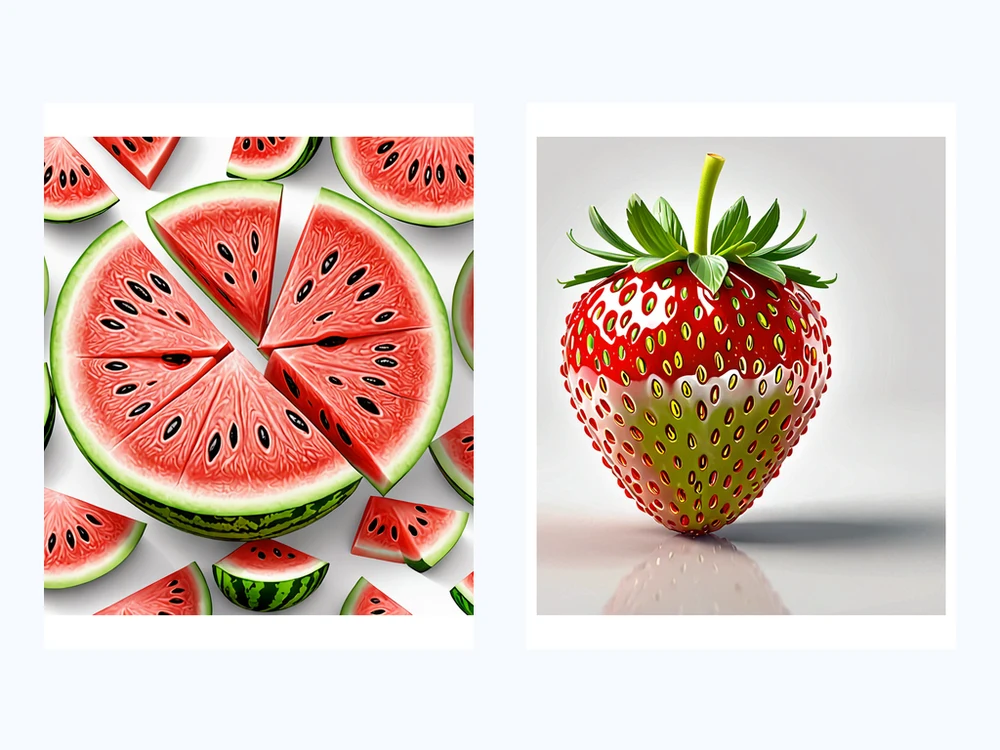
Choose your way to explore.
- What’s included
- 20 questions to try at your own pace. 3 printable question sets; choose one at a time.
- What you need
- A screen for the game. For printables, use paper and a pencil or crayons.
Food Size Comparisons
Look, read, or listen. Choose one answer, then see why it fits. Take your time.
Start the activityTry one together.
Which is usually bigger: the watermelon or the strawberry?
- About the same size
- Watermelon
- Strawberry
Show the answer and why
Watermelon
The watermelon is usually bigger.
This example uses a question from the activity. Open the game to try the rest at your own pace.
Watch. Think. Give it a try.
Play along with the video, then try the activity at your own pace.
Watch on YouTube Opens YouTube in a new tab.Choose a worksheet set.
Try one short set at a time. Each set lists its question range and where to find the separate answer guide.
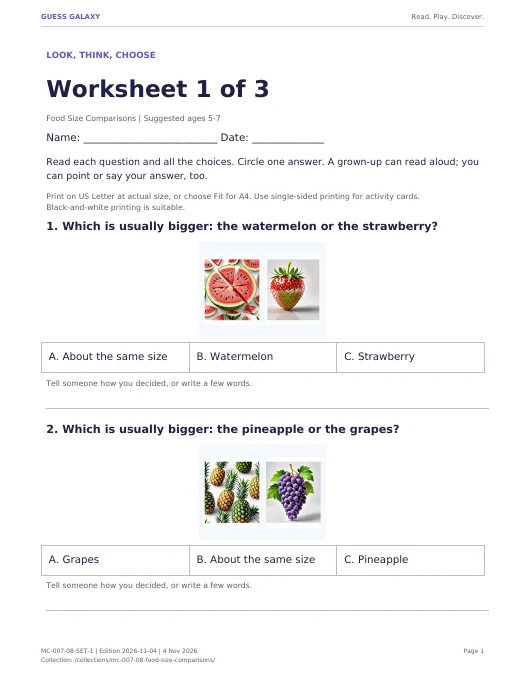
Worksheet 1 of 3 · Questions 1–7
Set 1 of 3 · 7 questions · questions 1–7
5 pages · PDF · US Letter · fit to A4
7 questions with space to explain your thinking. Separate answer guide starts on page 5.
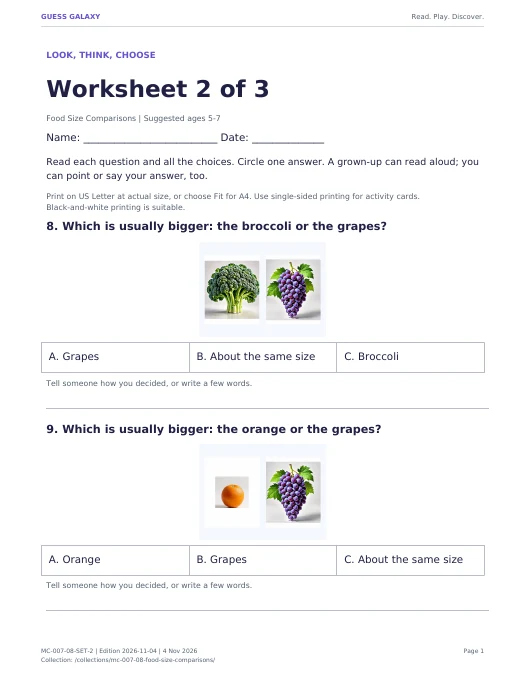
Worksheet 2 of 3 · Questions 8–14
Set 2 of 3 · 7 questions · questions 8–14
5 pages · PDF · US Letter · fit to A4
7 questions with space to explain your thinking. Separate answer guide starts on page 5.
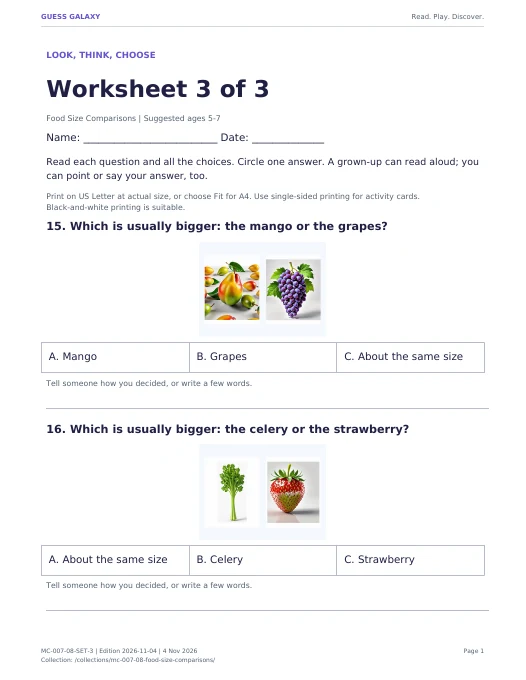
Worksheet 3 of 3 · Questions 15–20
Set 3 of 3 · 6 questions · questions 15–20
4 pages · PDF · US Letter · fit to A4
6 questions with space to explain your thinking. Separate answer guide starts on page 4.
Need a hand? See our printing tips.
Make it your own.
Choose a printable question set. Talk about how you found each answer, then make up one question together.